This time, I interviewed a family member who is not well known within the Family Fund, but who has asked for and received help from the fund a couple of times. Because we are all different and life does not always turn out the way we imagined it would.
How long have you been a member of the Family Fund?
My family wasn’t aware of the family fund; we only came into contact with it relatively recently (about 15 years ago, I think). All four of us (I have two sisters and a brother) then registered retroactively.
How old are you, where do you live and with whom?
I am 63 and I live alone in the countryside in Portugal.
Why Portugal? Have you lived there for long?
It will be 11 years in May. Before that, I lived in the centre of The Hague. I lived for 18 years in the last apartment I rented there. I enjoyed living there, but after a while I started to feel that I needed to move. That feeling was rather vague and I had no clear idea where I wanted to move to.
In 1996 and 2000, I was in Portugal as a vocal soloist with the USKO (Utrecht Student Choir and Orchestra). Both times, I felt drawn to the country and the friendly Portuguese people.
In 2012, as a conductor, I became involved in “The Lemurian Choir”, a project that later became known as “Pineal Toning”, where hundreds of people from all over the world gathered annually to chant for a better world. After the first event, which took place in Hawaii in 2012, there was a smaller event in Portugal in March 2013 to learn these “Pineal Tones”, where I assisted. I was staying with someone who one evening drew oracle cards for me. My question to the cards was: “What am I sowing here in Portugal?” She drew eight cards and with each card she drew, a voice in my head said loud and clear: “Move to Portugal”. I had never experienced anything like this before, so I decided to investigate.
From that moment on, I travelled to Portugal about 4 to 6 times a year. In Hawaii, there was a sizeable group of Portuguese people who welcomed me warmly and helped me get to know the country better. One of them suggested I take a look at Portalegre, where someone wanted to start a communal living project with yurts. When that project fell through, another acquaintance sent me an advertisement for a cottage for rent nearby. That’s where I ended up living. So it was a series of circumstances and synchronicities that led to my emigration and my first home.
I am now living in my fifth house here in Portugal, still in the same region, not far from the Spanish border. I enjoy moving and am currently looking for my next home. When I left the Netherlands, I got rid of almost all my belongings, except for a few boxes of odds and ends. I sent those to my new address by parcel post. I was in the middle of nowhere in a little house without windows, and I was euphoric! Letting go of everything is a bit scary, but I’ve never regretted it.
What is your profession?
I am a singer and have worked as such in the Netherlands for over 30 years. In the beginning, I mostly worked as a singer-actor, because I did a lot of musical theatre and opera, always as a freelancer. As an opera singer, I have sung many world premieres of modern operas as a soloist. I also sang as a soloist in all kinds of oratorios, from Bach to Verdi and Kurt Weill. For 10 years, I sang in the Renaissance ensemble Cappela Pratensis. I also sang in various productions with the jazz a cappella ensemble Tamam. In between, I occasionally sang in the Opera Choir, the Netherlands Chamber Choir and the Broadcasting Choir, among others. In short, I have done all kinds of things as a singer, both as a soloist and in choirs and ensembles.
From the outset, I also gave singing lessons and, over time, partly due to my increasing experience, both my interest in teaching and my practice as a teacher grew. After so many years of freelance singing in theatres, I began to find that work less interesting and limited my stage work to concerts.
From 2005 to 2008, I followed a postgraduate course at the Complete Vocal Institute in Copenhagen. This method is suitable for all forms of singing, from death metal to opera. Here I learned much better how to teach all kinds of people as a singing teacher, including those who want to sing in a non-classical style. I enjoyed that course very much, both as a teacher and as a singer, and it came along at just the right moment.
And now?
Soon after moving to Portugal, it became clear that opportunities for singing and singing lessons are very limited here. That is the disadvantage of living in such a sparsely populated area: few people are serious enough about singing to take lessons, and people here find it difficult to commit to group activities. The towns and villages are very small, nothing like in the Netherlands. Relatively few people have office jobs; many have outdoor jobs that are very seasonal. That is also why they do not easily commit to group activities. In the summer, there is no rain for four to five months and the sun shines brightly. Watering every day (at the right time) is crucial and a priority. People also eat much later in the evening here, which means that evening activities have to be planned very differently. Theatre performances and concerts, for example, usually start at 9.30 p.m.
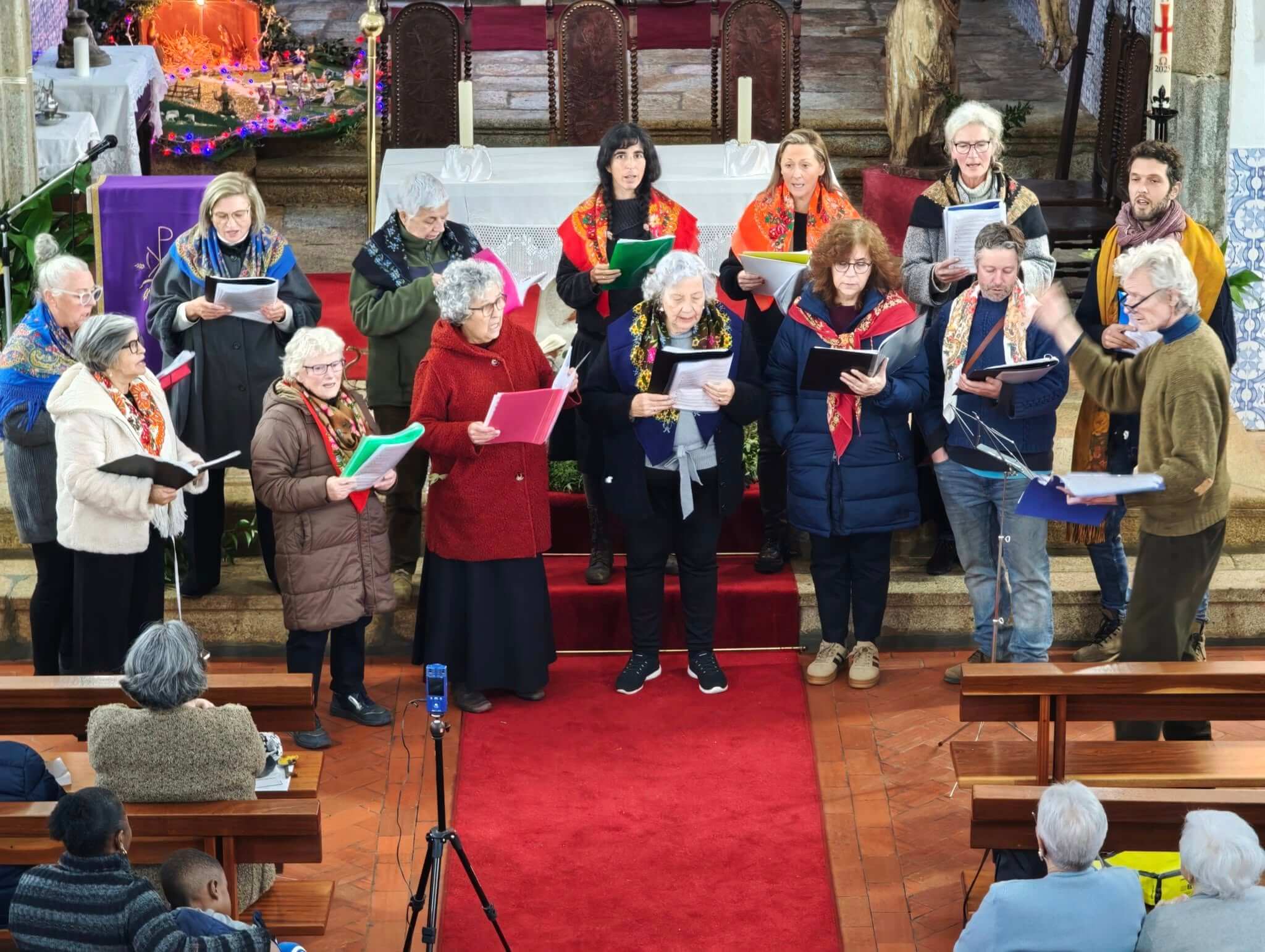
Nevertheless, since September 2024, I have been conducting a newly formed choir: Brado da Terra (Call of the Earth). I write arrangements and new compositions for it. We started with a Christmas programme, then a programme based on the Portuguese singer-songwriter Zeca Afonso, followed by another Christmas programme. We have even built up a reputation! That is the advantage of such a sparsely populated area: it gives people something to talk about.
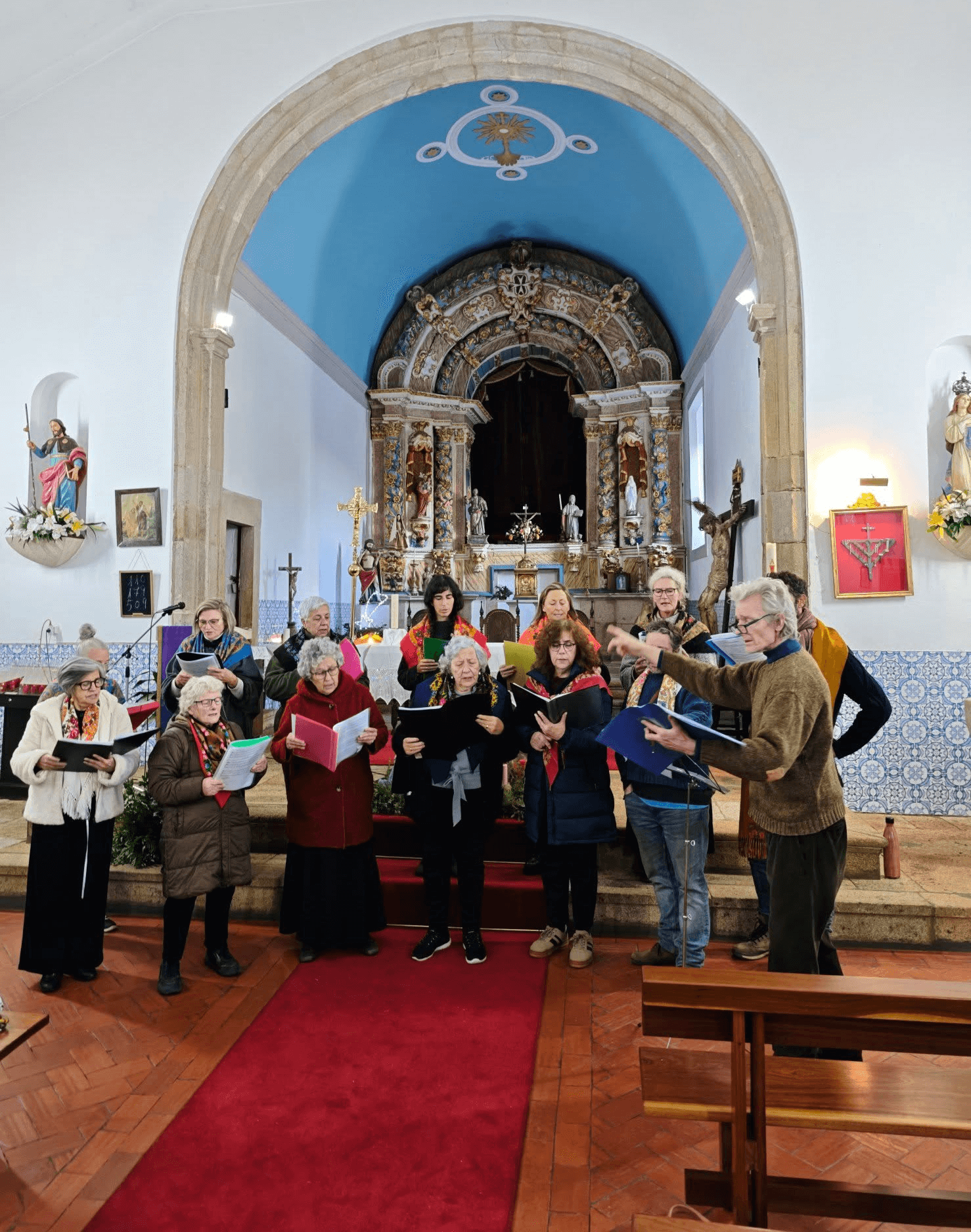
My starting point for the choir is that the participants (15 to 20 people) enjoy singing together. Nevertheless, we work hard and I strive for improvement, purity and subtlety, so the fun is also in rehearsing together with focus to achieve a resounding result. I also enjoy it very much myself, and it gives me stability and a monthly income from the choir members’ contributions.
For the past five years, I have also been singing with a friend who lives nearby. He is a beekeeper but also a passionate guitarist, and we occasionally perform under the name Lemuriberia. To give us more colour and possibilities, I started playing bass guitar over two years ago.
I recently started an online course to become an English teacher. The reason for this was a conversation with the mayor of the village where my choir rehearses. I wanted to know if their municipality could arrange a cultural subsidy for the choir. Unfortunately, that was not possible, but the mayor was very helpful. He told me that they were looking for an English teacher. My English is fine, but I had no idea about methodology, teaching materials, etc. I then found this course and started right away. After completing the course (within a few months), I will receive an internationally recognised certificate. Hopefully, I will be able to start teaching here soon, but with this course, I can also teach online.
What are your hobbies/interests?
I am quite single-minded. Music is such a broad field to explore, so that remains my main interest. A year and a half ago, I got a keyboard again, which I enjoy playing (at the conservatory, piano was my second instrument). I really enjoy arranging music for the choir. And I taught myself to play bass guitar so that I can also play in a band without always being the focus of the band (because that’s the singer). Unfortunately, I haven’t found a permanent group yet.
About 25 years ago, I took a course in astrology. That passion is still there, so I still look at the position of the planets from time to time, and occasionally I give astrological consultations to those who are interested.
Finally, I experiment with a vegetable garden, but due to the lack of rain in the summer, it is not always successful. I go to the Netherlands twice a year and in the summer it is difficult to find someone to water the plants. And besides, when the courgettes and pumpkins are ripe, you can buy them everywhere for next to nothing. Fortunately, seasonal fruit and vegetables are readily available here and not expensive at all.
What do you think is your best quality, and what is your worst?
Good quality: I have learned patience. That didn’t come easily to me. I used to be proud when I could do things as quickly as possible and sometimes found it difficult to accept that others were slower than me. Nowadays, the choir members occasionally praise me for my patience, while I feel that I project quite a lot of ambition onto them and demand a certain amount of discipline. But apparently I do that in a way that conveys passion and motivates them.
Both good and bad: I am stubborn, and that sometimes works for me and sometimes against me.
Bad trait: tidying up and cleaning sometimes take too low a priority.
Is there anything else you would like to add?
I would like to express my sincere gratitude to the fund for their repeated support. The first time, in 2017, was for the completion of my CD ‘Sun & Moon & Harmonics’ (see below), and later a few more times, for which I am extremely grateful. My life in Portugal is minimalistic, which is fine with me, but sometimes there are extra (car) costs and then it is very welcome to receive some support from the fund.
Links to Marc singing:
Sun & Moon & Harmonics
Sampler Lemuriberia
Marc the Lemurian (overtone singing, mantras and Pineal Toning)
Marc Drost Vocalise (older songs and videos)
0 comments